Introduction#
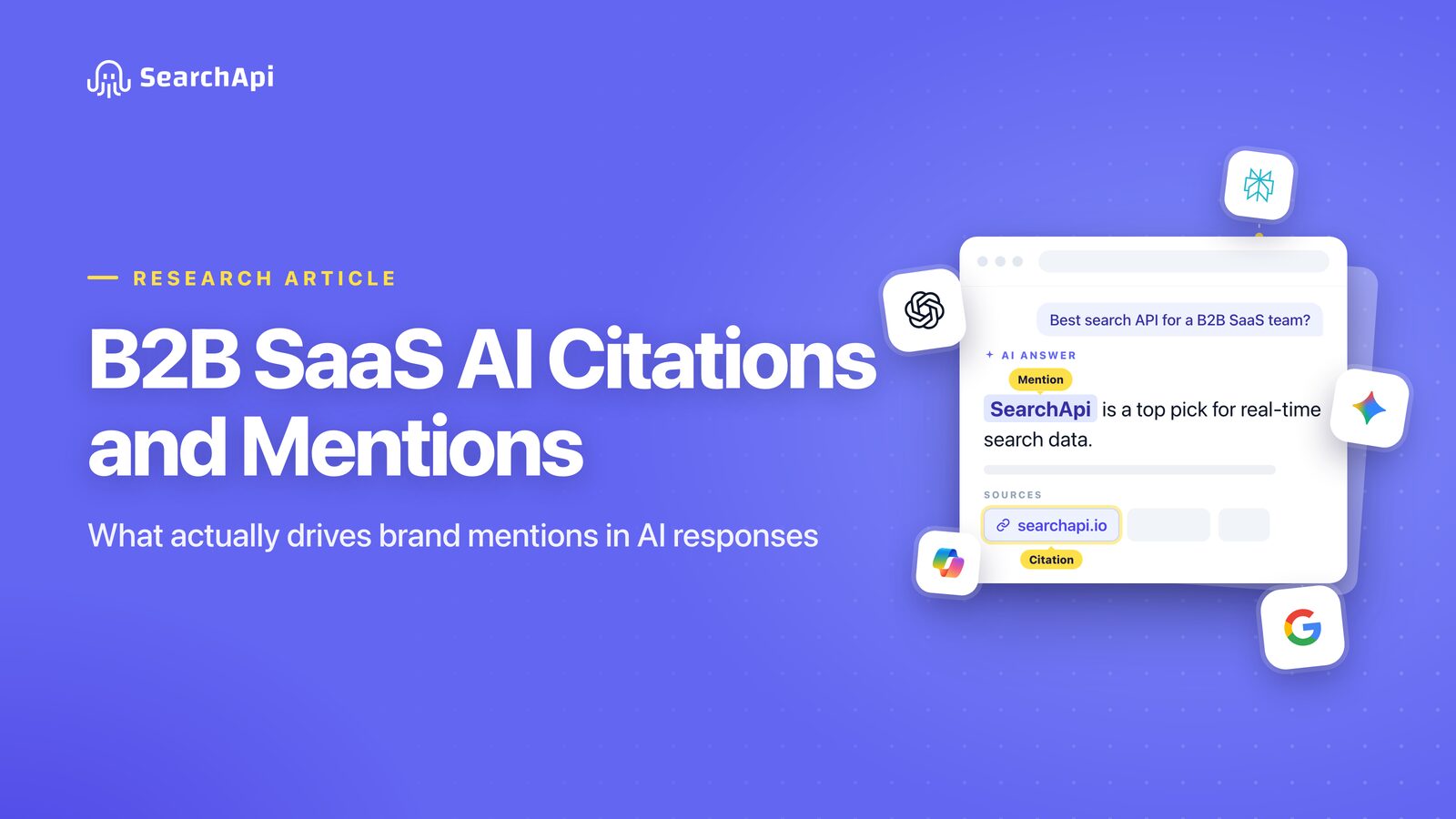
As more people rely on AI assistants in their buying process, businesses are trying harder than ever to get mentioned by them. There are two ways AI assistants can show your brand to users. These are ‘citations’ (a link to your website) and ‘mentions’ (your brand name being said). But what influences the content that agents cite and what causes brand mentions? Over six weeks we collected data from 13 high buying-intent prompts in the B2B SaaS category, across five different AI assistants, and studied the results.
Most of the time an AI engine names a brand, citing a page the brand does not own. 71% of the brands the AI answers name sit on a cited page someone else published, mostly another vendor’s “best X” listicle. Brands at the top of those lists are named far more often, but mostly because lists and engines agree on who is strong, not because of the rank itself.
How we did it#
We asked ChatGPT, Perplexity, Gemini, Copilot and Google AI Mode 13 buying-intent prompts across 47 scans, from August 14th to the 24th of September 2026. Each scan ran some of the prompts, up to five times on each engine. That gave 6,321 answers, 35,653 citations and 39,017 brand mentions. Every cited page was sorted into a content type, and every brand name was labelled by the role the answer gives it.
What gets cited#
A listicle is a page that ranks three or more options: “best X”, “top 10”, “alternatives to Y”. It is the page engines reach for first.
| Content type | Share of citations | Citations |
|---|---|---|
| Listicle | 54.2% | 19,307 |
| Product page | 15.7% | 5,611 |
| Documentation | 9.1% | 3,241 |
| Tutorial | 7.1% | 2,545 |
| Video | 4.3% | 1,541 |
| Community / forum | 3.7% | 1,307 |
| Guide / explainer | 2.4% | 839 |
| Code repo | 1.4% | 504 |
| Comparison | 1.1% | 401 |
| News / PR | 0.5% | 196 |
| Review platform | 0.4% | 138 |
| Other | 0.1% | 23 |
Most of these listicles are not independent. 92% of listicle citations go to a vendor’s site. Vendors write “best tools” posts, and engines use them.
What gets you mentioned#
Under mention we classify a brand mentioned in an AI engine answer. The useful question is not “does my own page get me named?” but “does a cited page that lists me get me named?”
For further reference, under the third-party we classify any page the brand doesn’t own, for example another vendor’s site, an independent publisher, a review platform, product documentation, or a “parasite” SEO platform (authority site anyone can publish on, such as Reddit, YouTube or Medium).
So we checked every brand on every cited page: 251,568 listings. A listing is one brand on one cited page in one answer. When a cited page lists a brand, the answer names it 36% of the time.
| Whose page lists the brand | Named | Named as a pick | Listings |
|---|---|---|---|
| Another vendor’s site | 37% | 22% | 159,637 |
| Independent publisher | 31% | 18% | 43,573 |
| The brand’s own site | 42% | 21% | 27,166 |
| Parasite platform | 37% | 9% | 21,018 |
When a cited page lists a brand, does the answer name it?
A listing on someone else’s page works almost as well as one on your own (37% against 42%), and there are eight times as many of them. That is the part a brand can influence.
Your own pages still matter, but only some of them. When an engine cites a page on a brand’s own site, this is how often the answer names that brand:
| Content type (brand’s own site) | Brand named | Named as a pick | Citations |
|---|---|---|---|
| Product page | 86% | 42% | 5,487 |
| Documentation | 78% | 36% | 1,234 |
| News / PR | 69% | 65% | 137 |
| Tutorial | 29% | 6% | 2,492 |
| Listicle | 24% | 13% | 17,852 |
| Comparison | 16% | 12% | 361 |
| Guide / explainer | 13% | 9% | 592 |
A vendor’s own listicle does more for its competitors than for its author. When the author lists itself on it, the answer names the author 29% of the time and the other brands on it 37% of the time.
| Content type | Own site | Other vendor’s site | Independent publisher | Parasite platform | All pages |
|---|---|---|---|---|---|
| Listicle | 28.5% | 36.9% | 30.0% | 35.6% | 34.8% |
| Tutorial | 31.9% | 33.2% | 52.2% | – | 33.9% |
| Community / forum | – | – | – | 29.3% | 29.4% |
| Product page | 86.9% | 43.0% | – | 86.7% | 74.5% |
| Documentation | 46.2% | 15.2% | – | – | 41.3% |
| Guide / explainer | 19.3% | 41.7% | 19.8% | 48.4% | 40.1% |
| Code repo | – | – | – | 38.0% | 38.0% |
| Comparison | 19.4% | 57.0% | 71.1% | – | 52.8% |
| Video | – | – | – | 72.3% | 72.2% |
| Review platform | – | – | – | 38.7% | 38.7% |
| News / PR | 59.4% | – | – | – | 57.6% |
What content types generate mentions#
For every brand an answer names, we looked at which cited pages in that answer list it, on the brand’s own site or anyone else’s. When several do, the credit is split evenly between them.
| Content type | All engines | ChatGPT | Perplexity | Gemini | Copilot | Google AI Mode |
|---|---|---|---|---|---|---|
| Listicle | 71.1% | 73.2% | 82.6% | 71.8% | 85.7% | 54.5% |
| Tutorial | 8.5% | 0.2% | 3.5% | 9.3% | 7.1% | 14.0% |
| Product page | 7.8% | 12.9% | 6.1% | 8.1% | 2.3% | 10.2% |
| Community / forum | 3.1% | 0.2% | 1.1% | 0.1% | 0% | 9.9% |
| Guide / explainer | 2.5% | 0.5% | 0.0% | 6.0% | 0.9% | 2.3% |
| Documentation | 2.2% | 4.7% | 3.6% | 0.6% | 1.1% | 2.9% |
| Code repo | 1.6% | 0.1% | 3.1% | 3.8% | 0.2% | 1.2% |
| Video | 1.3% | 0% | 0% | 0.2% | 0% | 4.4% |
| Comparison | 1.2% | 7.9% | 0% | 0.1% | 0% | 0.2% |
| Review platform | 0.6% | 0.1% | 0.1% | 0% | 2.2% | 0.3% |
| News / PR | 0.2% | 0.2% | 0% | 0.1% | 0.5% | 0.1% |
| Other | 0.0% | 0.1% | 0% | 0% | 0% | 0.0% |
Listicles drive both: 54% of citations and 71% of the mentions a cited page backs. Google AI Mode spreads the credit most (listicles 55%, tutorials 14%, product pages and forums 10% each). Copilot leans hardest on listicles (86%). That table counts the brand’s own pages and everyone else’s together. Split apart, they look different.
Most mentions trace back to someone else’s page:
| Engine | Third-party pages only | Own site and third-party | Own site only | On no cited page | Answer cites nothing | Mentions |
|---|---|---|---|---|---|---|
| ChatGPT | 43% | 8% | 7% | 13% | 30% | 7,543 |
| Perplexity | 53% | 35% | 11% | 1% | 0% | 2,506 |
| Gemini | 55% | 12% | 11% | 19% | 3% | 10,326 |
| Copilot | 69% | 5% | 13% | 13% | 0% | 8,830 |
| Google AI Mode | 58% | 26% | 12% | 4% | 0% | 9,812 |
| All engines | 56% | 15% | 11% | 11% | 7% | 39,017 |
Where the brands an answer names come from
ChatGPT is the exception again. 30% of the brands it names come from answers with no links at all, so nearly a third of its mentions can’t be traced to any page.
Does rank on the list matter?#
At first sight, rank decides everything.
| Rank on someone else’s cited listicle | Named | Named as a pick |
|---|---|---|
| #1 | 80% | 54% |
| #2–3 | 66% | 45% |
| #4–5 | 46% | 26% |
| #6–10 | 33% | 18% |
| #11+ | 5% | 3% |
Rank on someone else’s listicle vs named in the answer
But the brands at the top of lists are also the brands engines already rate. The three most-named brands drop only from 95% at #1 to 81% at #6–10. So we compared each brand only with itself, on the same engine and the same prompt:
| Same brand, engine and prompt | Named | Groups compared |
|---|---|---|
| Top 3 on someone else’s cited listicle | 65% | 234 |
| #6–10 on someone else’s cited listicle | 62% | 234 |
| Listed on at least one of the answer’s cited pages | 24% | 519 |
| Listed on none of them | 11% | 519 |
A top-3 spot adds about 3 points once brand strength is taken out. It does better than #6–10 in 44% of groups, worse in 22%, and the same in the rest. Being on the cited pages at all matters more. For the same brand, it roughly doubles the chance of being named (24% against 11%). It helps in half of the groups, hurts in 9%, and makes no difference in the rest, usually brands the engine names always or never.
How often the answer names the brand
Rank on someone else's cited listicle
Top 3
#6–10
Top 3 over #6–10: +36 points+3 points
Listed on the answer's cited pages
On at least one
On none
Listed over not listed: 7.5× as often2.2× as often
The same caution applies to a brand ranking itself first. Most self-ranked #1 spots (74% of those listings) belong to brands outside the ten most-named, and the answer names the author 35% of the time (10,820 listings). That says more about which brands write their own lists than about the #1 spot.
It also applies to the chart below. Without holding the brand fixed, the answer names one of the 25 most-named brands 5% of the time when none of its cited pages list it, and 62% when five or more do (5,873 answers with citations). Once the brand, engine and prompt are held fixed, listed against not listed shrinks from 37% vs 5% to 24% vs 11%.
How many cited pages list the brand, and how often the answer names it
None of this proves cause. Engines choose pages and names together. The same-brand comparison takes out brand strength and prompt fit, but not everything, so treat it as the best estimate this data allows. Settling it takes an experiment, not more data (see the end of the conclusions).
What each LLM prefers#
| Content type | All engines | ChatGPT | Perplexity | Gemini | Copilot | Google AI Mode |
|---|---|---|---|---|---|---|
| Listicle | 54.2% | 44.2% | 65.2% | 64.0% | 64.2% | 46.6% |
| Product page | 15.7% | 25.3% | 15.2% | 18.9% | 5.7% | 15.0% |
| Documentation | 9.1% | 19.7% | 7.4% | 2.0% | 7.4% | 9.4% |
| Tutorial | 7.1% | 0.4% | 8.6% | 7.9% | 13.7% | 6.4% |
| Video | 4.3% | 0.0% | 0.0% | 0.7% | 0.0% | 9.6% |
| Community / forum | 3.7% | 0.6% | 1.4% | 0.1% | 0.0% | 7.6% |
| Guide / explainer | 2.4% | 0.9% | 0.1% | 4.2% | 6.3% | 2.0% |
| Code repo | 1.4% | 0.1% | 2.2% | 1.5% | 0.6% | 1.7% |
| Comparison | 1.1% | 7.7% | 0.0% | 0.1% | 0.0% | 0.4% |
| News / PR | 0.5% | 0.8% | 0.0% | 0.4% | 1.6% | 0.5% |
| Review platform | 0.4% | 0.0% | 0.0% | 0.0% | 0.6% | 0.7% |
| Other | 0.1% | 0.4% | 0.0% | 0.0% | 0.0% | 0.0% |
- ChatGPT is the outlier. Fewest listicles (44%), most product pages (25%) and documentation (20%), and the only engine that often links comparison pages (8%). It links about 3 pages per answer and none at all in 28% of answers.
- Perplexity, Copilot and Gemini lean hardest on listicles: 65%, 64% and 64%.
- Copilot links the most tutorials (14%) and the fewest product pages (6%).
- Google AI Mode is the only engine that often links video (10%) and forums (8%). It also links the most: about 11 pages per answer, against about 3 for ChatGPT, Gemini and Copilot.
Who owns the pages being cited#
Vendor site = a page on any brand’s own site. Non-vendor site = any other site: independent publishers, review platforms, big-tech docs and parasite SEO platforms.
| Engine | Citations | Vendor sites | Non-vendor sites | Of which parasite platforms |
|---|---|---|---|---|
| ChatGPT | 4,446 | 84% | 16% | 0.2% |
| Perplexity | 6,349 | 90% | 10% | 5.8% |
| Gemini | 4,898 | 89% | 11% | 6.7% |
| Copilot | 4,313 | 81% | 19% | 1.7% |
| Google AI Mode | 15,647 | 69% | 31% | 21.4% |
| All engines | 35,653 | 79% | 21% | 11.6% |
Share of citations going to parasite SEO platforms
From any single brand’s point of view, most of that 79% is still third-party: a vendor’s listicle is the brand’s own page only for its author. Of all listings (a brand on a cited page in an answer), 89% are on a page the brand doesn’t own.
Parasite platforms are more than half of all non-vendor citations, but they are a one-engine story. YouTube and Reddit (1,497 and 882 links) are 15% of Google AI Mode’s links and 0.4% of the other four engines’ combined. Perplexity and Gemini use Medium and GitHub instead. The rest barely register: Stack Overflow 283, Chrome Web Store 118, G2 72, Quora 49, dev.to 45, LinkedIn 28, Substack 2, TrustPilot and Forbes 0.
The sites that actually drive mentions#
Here each mention is credited to the pages the brand doesn’t own, among the cited pages in that answer that list it. This counts the brands a source helped get named, not the pages it got cited for.
| Source (not the brand’s own site) | Mentions credited | All engines | ChatGPT | Perplexity | Gemini | Copilot | Google AI Mode |
|---|---|---|---|---|---|---|---|
| Other vendors’ sites | 19,571 | 76% | 85% | 74% | 71% | 93% | 62% |
| Independent publishers | 3,474 | 13% | 15% | 16% | 19% | 4% | 15% |
| 777 | 3.0% | 0.0% | 1.1% | 0.1% | 0% | 10.0% | |
| GitHub | 515 | 2.0% | 0.1% | 3.9% | 4.7% | 0.3% | 1.5% |
| Medium | 495 | 1.9% | 0% | 4.9% | 3.2% | 0% | 2.6% |
| YouTube | 427 | 1.7% | 0% | 0% | 0.2% | 0% | 5.5% |
| AlternativeTo | 171 | 0.7% | 0% | 0% | 0% | 2.7% | 0% |
| Stack Overflow | 171 | 0.7% | 0% | 0.1% | 0% | 0% | 2.3% |
| Chrome Web Store | 103 | 0.4% | 0% | 0% | 1.2% | 0% | 0.4% |
| dev.to, Quora, LinkedIn, Substack | 43 | 0.2% | 0% | 0.1% | 0% | 0.1% | 0.4% |
| G2 | 33 | 0.1% | 0.1% | 0.1% | 0% | 0% | 0.4% |
Other vendors’ sites are the biggest source on every engine, and 84% of what they back comes through their “best X” listicles. Independent publishers come second on every engine.
Parasite platforms are a Google AI Mode story. Reddit, YouTube, Stack Overflow, Medium and GitHub back 22% of the mentions it credits to third-party pages. On Perplexity it’s 10% (mostly Medium and GitHub), on Gemini 8%, and on ChatGPT and Copilot under 1%.
Conclusions#
Listicles drive both citations and mentions. The listicle that puts a brand in the answer is usually someone else’s. Being on the lists that AI engines cite matters more than where on the list you rank. Of the pages a brand owns, the product page is the one that reliably gets it named.
- 54% of citations go to listicles, and listicles drive 71% of the mentions a cited page carries (32,005 mentions).
- 71% of brand mentions are backed by a cited page the brand doesn’t own. 11% are backed by its own site alone (39,017 mentions).
- 24% vs 11%. Same brand, same engine, same prompt: named when the answer cites a page that lists it, against when it doesn’t. A top-3 spot on the list adds only about 3 points on top.
- 86% of cited product pages come with their brand’s name, and 42% as a pick (5,487 citations).
- 70% of brand mentions come with no link to the brand’s site (31,789 mentions of brands with a known site). Counting citations misses most of where a brand is named.
When an engine names a brand, does it link the brand’s site?
What to do:
- Get onto other people’s lists. 71% of mentions trace to a page the brand doesn’t own, and other vendors’ sites are 76% of that. Find the “best X” and “X alternatives” pages engines already cite for your category, and work to be on them. Your own listicle helps your competitors more than you: it names its author 29% of the time and the other brands on it 37%.
- Breadth before rank. Being on the cited pages roughly doubles a brand’s chance of being named (24% against 11%, same brand, engine and prompt). Moving up a list adds about 3 points. Get onto more of the lists engines cite before fighting for #1 on one.
- Make the product page your own mention page. It is named 86% of the time when cited. Say plainly what the product does, who it’s for and what it costs. Documentation comes next at 78%, and matters most for ChatGPT, where docs are 20% of its links.
- Aim parasite SEO at Google AI Mode. Reddit, YouTube and Stack Overflow back 18% of its third-party-credited mentions, and all parasite platforms together 23%. Medium and GitHub are worth it for Perplexity and Gemini. On ChatGPT and Copilot, parasite platforms back 3% or less.
- Report mentions and citations separately. 70% of mentions carry no link to the brand’s site. A citation-only report misses most of a brand’s visibility.
What we can’t show yet. This data shows where named brands appear, not that getting listed causes the naming. The test is simple and cheap. Get a brand onto, or up, a few listicles that engines already cite for its prompts. Then track its mentions over the next scans against prompts where nothing changed.